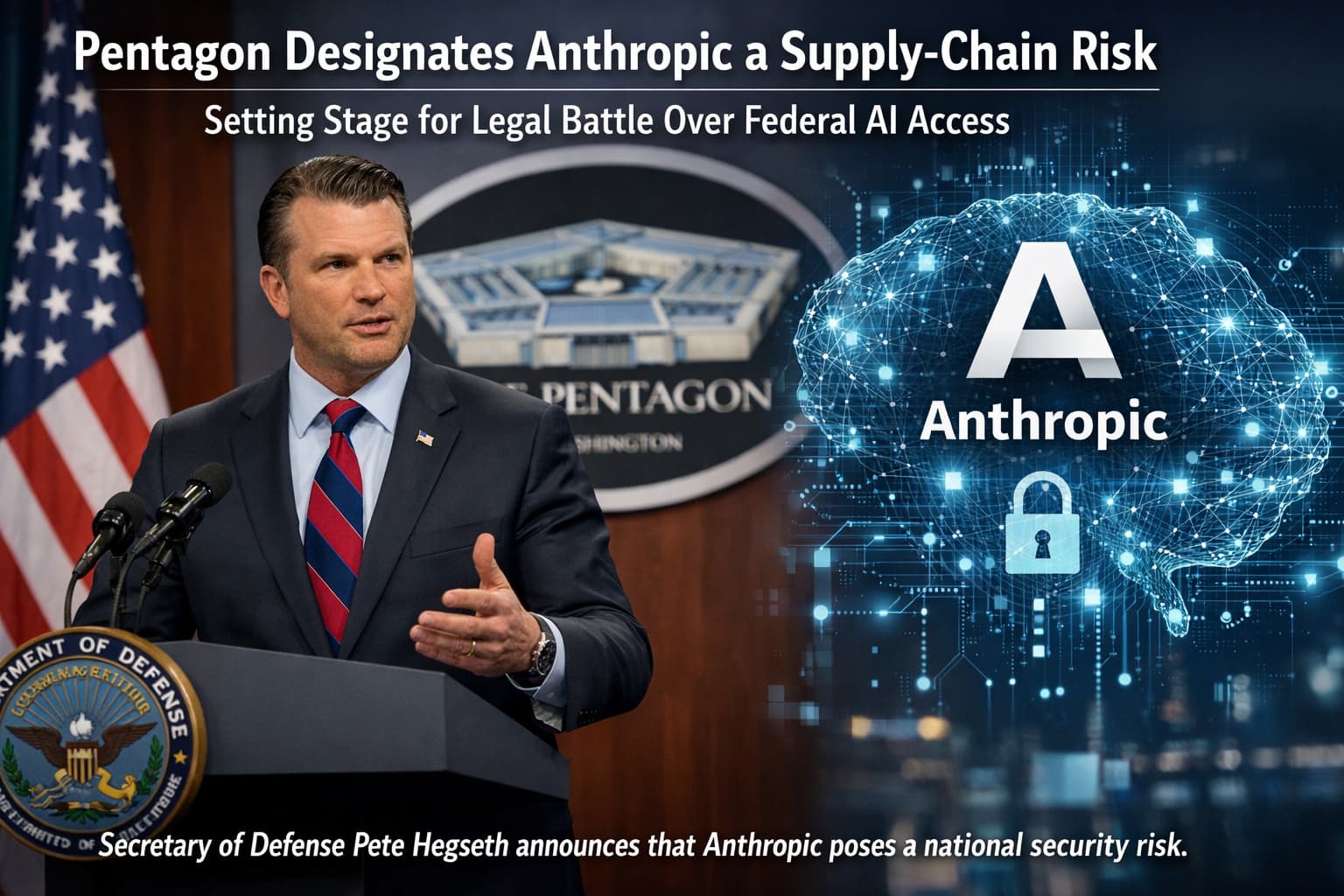
A significant dispute has emerged between one of Silicon Valley's most prominent artificial intelligence laboratories and the United States Department of Defense, placing the question of military AI governance squarely at the center of the technology industry's most consequential debate. At stake is not merely a contractual disagreement, but a fundamental contest over who holds authority to define the ethical boundaries of AI deployed in national security contexts. The clash between Anthropic and the Pentagon signals a broader reckoning that the defense establishment and private AI developers can no longer defer.
Anthropic, the AI safety-focused company behind the Claude family of large language models, finds itself in direct tension with military clients and defense contractors over the permissible applications of its technology. The core of the dispute concerns the use of Anthropic's systems in autonomous weapons platforms and advanced surveillance operations — two domains where the company has drawn explicit boundaries in its acceptable use policies. These are not casual guidelines; they represent the company's foundational commitments to responsible deployment of AI systems it considers potentially transformative and dangerous if misapplied.
The Pentagon's interest in cutting-edge AI capabilities is both understandable and well-documented. Defense planners have increasingly viewed large language models and related technologies as force multipliers across intelligence analysis, logistics, operational planning, and — most controversially — autonomous targeting systems. The department has invested billions in AI modernization efforts, and the appetite for commercially developed frontier models has grown in proportion to the capabilities those models now demonstrate. For institutions accustomed to setting their own operational parameters, the notion that a private company might constrain how its technology is used in classified or combat environments represents an unfamiliar and unwelcome friction.
What distinguishes this conflict from previous industry-government disagreements is the nature of Anthropic's position within the AI landscape. Unlike technology vendors who supply infrastructure or commodity software, Anthropic has built its market identity around safety research and the principled limitation of harmful use cases. The company's Constitutional AI methodology and its public commitments to avoiding catastrophic risk are not peripheral marketing claims — they are foundational to the organization's self-conception and, by extension, to its terms of service. Abandoning those restrictions to accommodate defense contracts would represent a significant compromise of the company's stated mission.
The autonomous weapons dimension of this dispute carries particular weight. International legal scholars, AI ethicists, and a growing coalition of technologists have argued that delegating lethal decision-making to algorithmic systems raises profound questions under the laws of armed conflict. Meaningful human control over the use of force is a principle embedded in humanitarian law, and critics argue that AI systems capable of identifying and engaging targets without direct human authorization challenge that standard in ways current regulatory frameworks are ill-equipped to address. Anthropic's reluctance to see its models integrated into such systems reflects an awareness of these legal and ethical fault lines.
Surveillance applications present a parallel set of concerns. The use of AI to process vast quantities of signals intelligence, monitor populations, or identify individuals of interest to military and intelligence agencies raises serious civil liberties questions even when directed at foreign nationals. When such capabilities are built on commercial AI platforms, the companies supplying those platforms become implicated in outcomes they may have limited visibility into and even less ability to oversee once deployment occurs. The opacity of national security operations makes post-deployment accountability essentially impossible for private vendors, a reality that appears to inform Anthropic's cautious posture.
The structural dynamics of the dispute illuminate a tension that will only intensify as AI capabilities advance. Defense agencies operate under classification regimes and operational security requirements that are fundamentally incompatible with the transparency and auditability that responsible AI deployment arguably demands. Private AI developers, particularly those with genuine safety commitments, require insight into how their systems are being used in order to monitor for misuse, gather feedback, and maintain meaningful control over their technology's impact. These two imperatives are, in many respects, irreconcilable — and no amount of negotiation is likely to fully bridge that gap.
For decision-makers in both government and industry, the Anthropic-Pentagon conflict presents a clarifying moment. Organizations evaluating AI partnerships with defense clients must now grapple openly with questions that were previously allowed to remain ambiguous: What uses will they permit? What oversight mechanisms are they prepared to demand? And at what point does the revenue opportunity presented by government contracts come into irreconcilable conflict with the ethical frameworks that give an AI company its credibility and, ultimately, its long-term viability? These are not abstract philosophical questions — they are governance decisions with concrete operational consequences.
The broader implications extend well beyond Anthropic and the Pentagon specifically. As governments around the world accelerate their investment in military AI, and as frontier model capabilities continue to expand, the question of how commercial AI development interacts with national security imperatives will become one of the defining policy challenges of the decade. The absence of robust international frameworks governing military AI — analogous to arms control treaties that have historically constrained other categories of destabilizing weapons technology — leaves the field governed primarily by the individual choices of companies and governments. In that environment, disputes like the one now playing out between Anthropic and the Department of Defense are not aberrations. They are previews of conflicts to come.