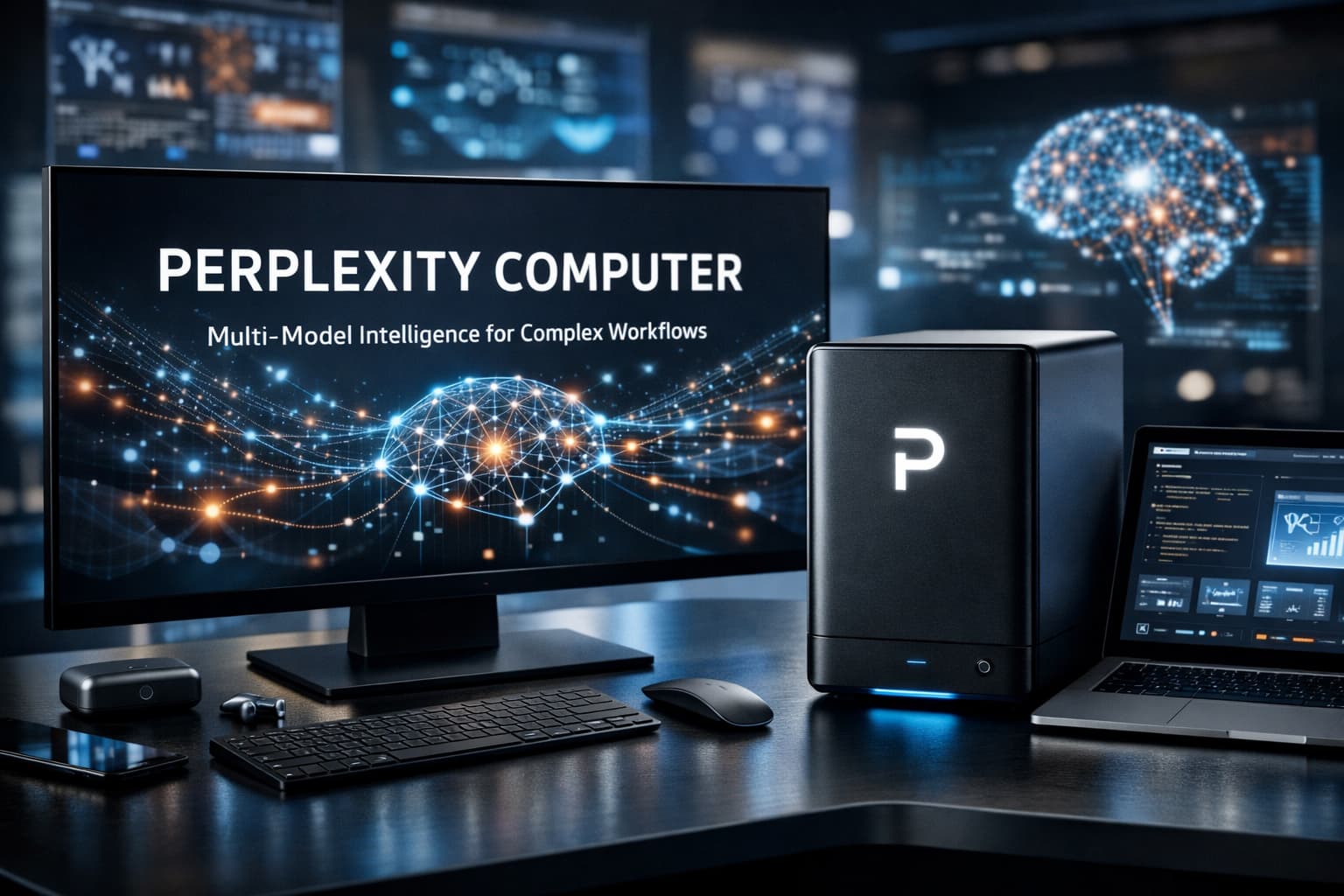
Perplexity has signaled a deliberate shift in strategic direction this week with the release of Perplexity Computer, an agentic tool designed to handle complex, multi-step workflows entirely in the cloud. Rather than pursuing mass-market adoption, the company appears to be doubling down on a narrower, higher-value audience — one it describes as professionals making "GDP-moving decisions." The launch marks one of the most ambitious product expansions the AI search company has undertaken since its founding.
According to Perplexity, the new tool "unifies every current AI capability into a single system." Operating as a computer user agent, it draws on 19 different AI models and is capable of spawning subagents to address specific components of a broader task. Example workflows published on the company's website demonstrate the tool collecting financial, statistical, and legal data, synthesizing that information into analyses, and delivering findings as fully rendered websites or interactive visualizations.
Access to Perplexity Computer is currently restricted to subscribers of the company's top-tier plan, Perplexity Max, priced at $200 per month. Because the tool operates exclusively in the cloud, it sidesteps some of the security risks associated with locally-run agentic systems. That distinction may prove meaningful as enterprise clients weigh the risks of deploying AI agents within sensitive operational environments.

The product's debut was not without complications. Perplexity had invited press to a background briefing with executives and planned to include a live demonstration — but the demo was canceled after engineers identified flaws in the product just hours before the event. TechCrunch has not conducted an independent hands-on evaluation of the tool, and its real-world performance remains to be assessed under scrutiny.
The launch of Perplexity Computer represents the latest chapter in a corporate evolution that began with a search-engine-style answer interface built atop frontier models. The company subsequently introduced the Comet web browser last summer, extending its footprint beyond search. Executives at the briefing — who requested anonymity — noted that competitors, including Google, have since redesigned their own products to resemble Perplexity's offerings, a development they characterized as both validation and a competitive threat.
Central to Perplexity's current strategy is what its executives describe as the multi-model future of AI. Rather than consolidating around a single large language model, the company routes queries to whichever model is best suited for a given task. Internal data from December 2025 illustrates this approach in practice:
- Queries involving visual outputs were most frequently routed to Gemini Flash
- Software engineering tasks were predominantly handled by Claude Sonnet 4.5
- Medical research queries were directed to GPT-5.1
This model-routing architecture also includes a feature called Model Council, which allows users to query multiple models simultaneously. Separately, Perplexity has acknowledged running modified open-source Chinese-built LLMs to reduce costs — a practice it previously obscured from customers, drawing criticism. Executives indicated the company now intends to apply the technique transparently as a legitimate cost-optimization mechanism.
"Multi-model is the future," one Perplexity executive argued, adding that models are specializing, not commoditizing.
The company's pivot toward enterprise and professional users comes alongside a notable retreat from advertising. Perplexity was among the first AI companies to introduce ads into its product, but reversed course late last year, with executives stating at the briefing that advertising had undermined users' confidence in the accuracy of the answers they received. The decision reflects a broader repositioning around trust and premium utility rather than scale.
That positioning stands in sharp contrast to the trajectory of rivals. OpenAI, for instance, reported 800 million weekly users and began testing advertising in ChatGPT in 2025. Perplexity's own total user base remains in the tens of millions — a gap executives appear unconcerned by.
"You don't hear us talk about MAUs ever, because we're not actually on a mission to get as many users as possible," one executive stated.
To reinforce its credibility in the enterprise research segment, Perplexity recently published a benchmark called Draco, designed to evaluate performance on complex research tasks. Predictably, the company's own deep research offering ranked ahead of competing products such as Gemini on the benchmark. Perplexity also claims to have achieved independence from third-party APIs for its web index, now operating its own AI-optimized search API.
Despite these competitive assertions, the unit economics of the company's subscription model invite scrutiny. Offering flat-rate access to multiple simultaneous model queries — particularly through Model Council — presents cost management challenges that have not been fully disclosed. Executives maintained that, absent major infrastructure expenditures and with what they described as high margins on subscription fees, the company retains adequate flexibility to allocate compute resources strategically.
Community feedback, however, suggests some friction. The Perplexity subreddit has seen recurring complaints about stricter rate limits across both free and paid tiers — a pattern some users interpret as a revenue-driven tightening of previously generous access. One executive dismissed these concerns categorically.
"Any discussions on the free tier being made worse or rate-limited is completely false," the executive said.
Looking ahead, Perplexity has confirmed that the Comet browser will arrive on iOS next month. The company is also preparing for a developer conference, Ask, scheduled for March 11 in San Francisco, where it plans to promote third-party integration with its API. For a company that once measured success by query volume, the internal metrics appear to have shifted — one executive noted that morning reviews now focus on revenue figures rather than daily query counts.